
If you want to do high speed honing, use paper wheels. But, I've found that the leather wheel at Tormek speed works better for me.
- Welcome to Tormek Community Forum.
News:
Welcome to the Tormek Community. If you previously registered for the discussion board but had not made any posts, your membership may have been purged. Secure your membership in this community by joining in the conversations.
www.tormek.com
This section allows you to view all posts made by this member. Note that you can only see posts made in areas you currently have access to.
#2
General Tormek Questions / Re: Unidentified accessory
October 10, 2026, 05:29:10 AM
It is for sharpening scraper blades for woodturning.
#3
General Tormek Questions / Re: Squareness
October 09, 2026, 04:39:43 AM
Enrico, if you are referring to the SE-77, this jig can help https://sharpeninghandbook.info/Jigs-SE-77-Alignment.html.
#4
General Tormek Questions / Re: Removing the Grinding Wheel between Sharpening Sessions
September 26, 2026, 09:26:11 PMQuote from: Herman Trivilino on September 26, 2026, 07:36:27 PMYes, time has a tendency of passing quickly. It's quite easy for me to walk away from a sharpening session and leave the machine unattended for weeks or even months. I've learned my lesson. Remove the water trough, empty and thoroughly rinse, and remove the grindstone immediately after every session.I do the same as Heman.
#5
General Tormek Questions / Re: grinding wheel spindle
September 19, 2026, 08:03:58 PM
Steven,
Herman is exactly right.
By the way, I've catalogued the recommended upgrades to the SuperGrind 2000, including what I've upgraded on my own machine at: https://sharpeninghandbook.info/PurchasedAnOldTormek.html
Kind regards,
Rich
Herman is exactly right.
By the way, I've catalogued the recommended upgrades to the SuperGrind 2000, including what I've upgraded on my own machine at: https://sharpeninghandbook.info/PurchasedAnOldTormek.html
Kind regards,
Rich
#6
Wood Turning / Re: Negative rake scrapper problem
September 18, 2026, 05:10:02 AM
Dedicate an SVD-110 for Scrapers
https://sharpeninghandbook.info/TimeSavingTipsForTheTormek.html#DedicatedScrapers
https://sharpeninghandbook.info/TimeSavingTipsForTheTormek.html#DedicatedScrapers
#7
General Tormek Questions / Re: grinding wheel spindle
September 16, 2026, 04:10:49 AM
The MSK-250 Stainless Steel Shaft with EzyLock is a nice upgrade for that machine.
#8
General Tormek Questions / Re: grinding wheel spindle
September 16, 2026, 12:17:29 AM
You should be able to hold the honing wheel
#9
Drill Bit Sharpening / Re: Getting the secondary bevel correct using the DBS 22
September 12, 2026, 03:01:38 PM
I agree with John & Rick.
#10
Hand Tool Woodworking / Re: having 5 or six chisels to sharpen
September 10, 2026, 04:11:40 AM
I recommend you take each chisel from start to finish, then begin again on the next chisel. You will experience less frustration with re-attaching the jig to the chisel.
#11
Drill Bit Sharpening / Re: Getting the secondary bevel correct using the DBS 22
September 02, 2026, 01:59:49 PM
Tony,
At the Sharpening Handbook, I've cataloged 4 really good videos for using the DBS-22 to sharpen twist drills: https://sharpeninghandbook.info/GT-DrillBits-Twist.html.
Rich
At the Sharpening Handbook, I've cataloged 4 really good videos for using the DBS-22 to sharpen twist drills: https://sharpeninghandbook.info/GT-DrillBits-Twist.html.
Rich
#12
General Tormek Questions / Re: Is there a way to prevent the spacer coming off when swapping grinding wheels?
August 31, 2026, 03:08:07 PMQuote from: tgbto on August 31, 2026, 02:00:54 PMRick, it's a nice idea. My first thought was "let's print it with a Igus filament", although buying a roll just for one washer may slightly impair the financial equationWhen I looked at the stainless steel washer on the machine, it did not show significant wear. So that is good.
Quick question : Aren't your concerned with the plastic washer wearing down with time ?

Regardless, I am not concerned as I can print another in less than an hour.
I am not familiar with Igus filament, so I cannot comment on that. I used ABS to print the ones I am using, but PETG may be a better choice if you are concerned about it wearing down too soon.
Of course, you could take your current one to a machinist friend and get it modified.
#13
General Tormek Questions / Re: Is there a way to prevent the spacer coming off when swapping grinding wheels?
August 28, 2026, 09:11:56 PM
I designed and printed a part using ABS. It seems to work quite well, though it may also be due to the bore for the 3D-printed part being a little tight on the spindle shaft.
The original one is depicted to the left, and the 3D-printed on on the right.
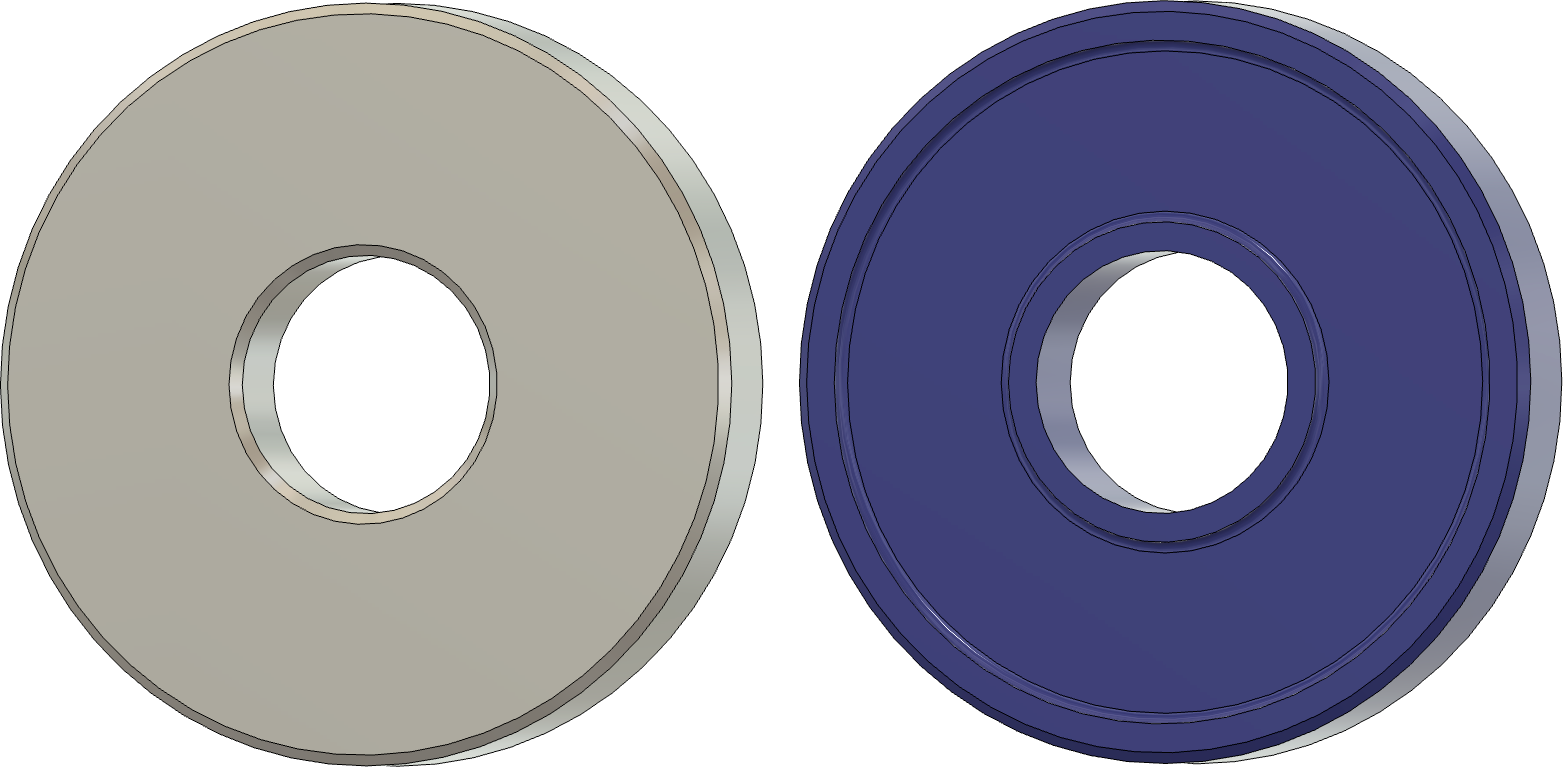
If you want to print one for yourself, it is available on the Sharpening Handbook: https://sharpeninghandbook.info/Jigs-GrindstoneWasher.html.
The original one is depicted to the left, and the 3D-printed on on the right.
If you want to print one for yourself, it is available on the Sharpening Handbook: https://sharpeninghandbook.info/Jigs-GrindstoneWasher.html.
#14
Knife Sharpening / Re: New angle jig KS-123
August 27, 2026, 05:01:43 AMQuote from: MARC LAVINA on August 25, 2026, 10:06:37 PMHello everyone, I am new to the forum. I have been using T8 since 2020 with standard, CBN and diamond wheels, mostly on 8" kitchen knives and a little less on my folder collection. I was so happy when KS-123 came out because of the time economy compared to the Edding/sharpie method. I check my angles before and after sharpening with a laser goniometer. I experienced a consistent difference of 1 degree that the KS-123 is below the reading of my laser instrument. Can anybody in this forum confirm that difference by his own experience?When I use the KS-123 and compare the ground edge to my laser goniometer, I do not see such a discrepancy.
#15
General Tormek Questions / Re: Is there a way to prevent the spacer coming off when swapping grinding wheels?
August 27, 2026, 04:58:50 AM
I believe there is a solution if you have a metal lathe.
I asked Claude (an AI),
Capillary adhesion is experienced between the grindstone and the washer on a Tormek grinder. If the washer had most of the surface dished out (as if it were a bowl), would this surface adhesion become almost negligible?
The response was,
Yes, and quite significantly — for two separate reasons tied to the two mechanisms:
Capillary suction (Laplace pressure)
This force is roughly proportional to the contact area where the thin film exists. Dish out the center and that area shrinks to just the outer rim, so the suction force drops proportionally to how much area you've removed.
Stefan (viscous squeeze-film) adhesion
This is the bigger effect for a fast pull-apart, and it's the one that benefits most dramatically. The Stefan equation says resistance scales with the fourth power of the radial distance water has to travel to escape:
F ∝ R⁴ / h³
That R⁴ term exists because water at the center of a flat disk has to travel the full radius outward to escape when the plates squeeze together — a long, slow path. If you dish out the center, that water is sitting in an open reservoir with nowhere to build pressure — it's not trapped. Only the water in the thin rim band actually gets squeezed, and it only has to travel the width of that rim (not the full radius) to escape. Since the effective flow-path length drops so much, and the force depends on that length to the 4th power, the reduction is dramatic — often far more than proportional to the area removed.
Net effect: You wouldn't make it perfectly zero — there's still a wetted rim doing some work — but you'd cut both the suction and (especially) the "stuck fast" viscous resistance dramatically. This is essentially why things like vacuum-cup release valves, dimpled/grooved plates, and relief channels are common tricks for beating stiction — you're shortening the escape path for the trapped film rather than trying to eliminate the film itself.
You could test this premise using a 3d printed part.
I asked Claude (an AI),
Capillary adhesion is experienced between the grindstone and the washer on a Tormek grinder. If the washer had most of the surface dished out (as if it were a bowl), would this surface adhesion become almost negligible?
The response was,
Yes, and quite significantly — for two separate reasons tied to the two mechanisms:
Capillary suction (Laplace pressure)
This force is roughly proportional to the contact area where the thin film exists. Dish out the center and that area shrinks to just the outer rim, so the suction force drops proportionally to how much area you've removed.
Stefan (viscous squeeze-film) adhesion
This is the bigger effect for a fast pull-apart, and it's the one that benefits most dramatically. The Stefan equation says resistance scales with the fourth power of the radial distance water has to travel to escape:
F ∝ R⁴ / h³
That R⁴ term exists because water at the center of a flat disk has to travel the full radius outward to escape when the plates squeeze together — a long, slow path. If you dish out the center, that water is sitting in an open reservoir with nowhere to build pressure — it's not trapped. Only the water in the thin rim band actually gets squeezed, and it only has to travel the width of that rim (not the full radius) to escape. Since the effective flow-path length drops so much, and the force depends on that length to the 4th power, the reduction is dramatic — often far more than proportional to the area removed.
Net effect: You wouldn't make it perfectly zero — there's still a wetted rim doing some work — but you'd cut both the suction and (especially) the "stuck fast" viscous resistance dramatically. This is essentially why things like vacuum-cup release valves, dimpled/grooved plates, and relief channels are common tricks for beating stiction — you're shortening the escape path for the trapped film rather than trying to eliminate the film itself.
You could test this premise using a 3d printed part.